Iasa Hatem
LAS 101
Dr. Britta Crandall
December 9, 2022
Right-wing populist, Jair Bolsonaro, has been head-to-head against Indigenous communities since early in his career. Dating back to 1998 when he explicitly shamed not having finished off all Indigenous like Americans did “It’s a shame that the Brazilian cavalry hasn’t been as efficient as the Americans, who exterminated the Indians” (Bolsonaro, 1998). Bolsonaro’s racism did not stop at comments before, during, and after his electoral campaign. Rather, he made sure his words were accompanied by actions. He loosened the right to own a firearm, and encouraged farmers to use it in case “they might need it”, he cut off protection over Indigenous lands and began massive privatization and mining activities in the Amazon rainforest. The Amazon Rainforest, in addition to being the richest ecosystem in Latin America, is also home to many valuable non-renewable resources, compassing vast amounts of gold, oil, and tin (Somma, 2021). Covid-19 was a turning point in Bolsonaro’s policies in Brazil, as he exploited the moment when the world was not watching to extract the Amazon rainforest from all its resources. His programs caused the deliberate violent conflict and assassination against Indigenous peoples living in the Amazon rainforest – many of whom are in danger of extinction. In this paper, I will argue that Bolsonaro’s policies in the Amazon rainforest were for the benefit of profit maximization, disguised as “agribusiness” which all fed into Bolsonaro’s racism against Indigenous peoples.
Bolsonaro’s Politics against Indigenous explained:
Bolsonaro’s politics against Indigenous peoples of Brazil will be classified into three categories; societal, economic, Covid-19 exploitation.
1. Socially and politically:
The foundation of the current Brazilian social system is largely the same as it was during and after Portuguese colonization. Even though Brazil is one of the biggest economies in the world, it is highly segregated in terms of class, race, and ethnicity. Those who are of Indigenous groups or descent are discriminated against structurally. Because the wealth distribution in Brazil hasn’t changed much, with the white, European descendants getting easier life opportunities, Indigenous peoples have fewer chances at education, finding a stable job, and reaching their own goals (Pellegrini et al., 2021). As a minority constituting only 1% of the population of Brazil, their voices are often not heard.
Furthermore, the timing of Bolsonaro’s emergence to the Brazilian political arena is crucial for his success and the success of Bolsonarism (Bolsonaro ideology, very similar to Chavismo in Venezuela). Since the previous political party, the Worker’s Party (or PT for Partido dos Trabalhadores), was caught in one of the biggest corruption scandals in history, the Lava Jato, the trust and confidence of the public in the leftist party was beginning to tremble, as the Pink Tide was weakening. The right– on the very front is Bolsonaro, was emerging quickly, an ideology that people adopted quickly. This was important because even though Bolsonaro openly racialized against Indigenous Brazilians, there was no other turning point. It only fueled their resentment towards the more inclusive yet corrupt approaches of the left. This included the marginalized groups whom the previous government was supporting, and that Bolsonaro pointed out was bringing down their middle class. Hence, with intense support towards the wealthy, he was able to get support against his policies towards Indigenous in the congress. So much so, that he was able to get approval from the congress to remove legally demarcated territories so he could start his mining business in the Amazon rainforest, which is home to 680 of Indigenous areas (Prange, 2022) Because of this structural racism, that gained approval in the congress, Indigenous people are left helpless in the face of this systemic oppression in Brazil in Bolsonaro’s era.
Marcelo Xavier da Silva was appointed by Bolsonaro as the new FUNAI (the National Indian Foundation) president. In his presidency, Bolsonaro was able to undermine the agency and autonomy of FUNAI, by ordering da Silva to perform criminal investigations against Indigenous leaders, and increasing bureacracy in FUNAI. Because FUNAI is the representative and protector of the Indigenous people and their lands since (insert year), da Silva’s actions decreased FUNAI’s legitimacy both for the Indigenous and for the congress. Accusing Indigenous leaders of crimes possibly created uncertainty and restrictions in the ability of Indigenous groups to claim their property of land– in a way, these criminal investigations were to distract, divide and debilitate Indigenous voices, so much so that 241 property demarcations have been halted since 2019 (Human Rights Watch, 2022). He further attempted to shift FUNAI from under the care of the Ministry of Justice to the Minisitry of Human Rights, Women, and Family, whose goals do not align with Indigenous goals. Removing FUNAI from under the Ministry of Justice would open the doors for human rights violations much more openly than they are now. Unfortunately, this move was objected by the congress. Bolsonaro’s most explicit moves against Indigenous people was the Marco Temporal, or the Milstone Thesis. This thesis reframed the demarcation of land in a way that passively weakens Indigenous rights; the thesis states that Indigenous groups can claim Indigenous territories if they already possessed the land at the time of the declaration of the new Brazilian constitution in 1988 (Fishman, 2021). Because it is hard for Indigenous groups to claim their land, Bolsonaro allowed any private or public investments in these lands, making it legal to invade Indigenous territory (Prange, 2022). Almost 700 areas are registered by FUNAI as indiegnous territory, and only two-thirds of the total are protected by law and under the constitution. However, this is not the case in reality, as Bolsonaro continuously finds ways to override the constitution. To accomplish this, he restructured the Ministry of Environment by decreasing the number of member seats from 96 to 23 members, with only 4 seats assigned for public representatives (Menezes et al., 2021). Furthermore, all manager roles for ICMBio (the administrative branch of the Ministry of the Environment) were occupied by officials with military backgrounds, further sabotaging the agency of the Ministry of the Environment.
Marcelo Xavier da Silva played a crucial role in Bolsonaro’s new game arena. His political corruption went as far as reframing the definition of the Indigenous people, and only those who fall under specific “technical/scientific criteria” would be able to recognize themselves as Indigenous. This move undermines the cultural aspects of identity, were communities who have shared traditions, history, and customs might not be able to identify with other Indigenous groups. It additionally decreases pressure from the government to demarcate as many groups as some of them might not be recognized anymore. On a social level, this new definition would take away from Indigenous people’s autonomy and right to choose for themselves who they are based on their own culture.
2. Economic level:
Bolsonaro’s liberalist policies focused on de-nationalization, investment in private projects and increasing private profits. By encouraging wide business privatization and foreign investment, Bolsonaro gained more support from the wealthier layers of society that would ensure that his liberalist agenda would succeed. These policies encouraged the mining and industrialization of the Amazon rainforest, a process that is referred to as “agribusiness”. As he stated early in presidency, he loosened firearm restrictions, and encouraged farmers and miners to take “appropriate steps” if they encounter an Indigenous group. As mining activity increased in the Amazon rainforest, so did police presence, who would shoot into the air (and sometimes at Indigenous people) to disparse, intimidate, and indirectly evict them from their homes. So much so that police violence against Indigenous groups increased to an average of 14 people killed by police per day (Webb, 2018). Deforestation of the Amazon has increased to a peak point where it reached 36,850 fires in 2022, threatening the livelihood of several Indigenous groups (Kimbrough, 2020). Furthermore, Bolsonaro has repeatedly stated that he would not protect Indigenous people saying, “there won’t be a centimer demarcated for Indigenous reserves” (Fisherman, 2021). As agribusiness forms one-fourth of the total domestic product (or GDP) and less than half the total exports in Brazil, it makes it challenging for Brazilians to give up on Agribusiness, which amounts to 9.12% of employment in Brazil (World Bank, 2020). Across Brazil, deforestation has increased 138% under Bolsonaro since 2016-2018. Simultaneously, logging, mining, and the extraction of natural resources has increased by 137% in 2020 compared to 2018 (Human Rights Watch, 2022). Mining does not only pose legal problems, such as invading Indigenous lands and deforestating, but it causes health problems as well. To extract gold, miners spray mercury into sediment, which pollutes water and surrounding ecosystems. Because of this unregulated usage of mercury, increased poisoning and malaria infections are being recorded among Indigenous people (Weisbrod Surma, 2021).
3. Covid-19:
As the the world was focused on fighting the new pandemic, Bolsonaro sparked controversy because of hiS disbelief in Covid-19, denying science, and discouraging people from getting vaccinated (France 24, 2020). While these were all problems, they partially hid the policies that he was trying to push in the congress during Covid-19. He exploited the moment of weakness in the world, and the diverted eyes from individual countries’ problems to increase deforestation and mining activity in the rainforest, with fires reaching almost 45 thousand in 2020 alone. During covid, he fired of Minister of the Environment and trued to dissolve the ministry. Second, he did not provide proper healthcare system for Indigenous people during the pandemic, until the Supreme Court intervened. The court order mandated that the government drew a pandemic plan for the Indigenous areas, as they were being infected by the virus without proper measures. Some human right groups claimed this was similar to genocide and extermination.
Is Bolsonaro exclusive in his actions?
Indigenous peoples in Brazil have been a largely marginalized group since the colonization of the Portuguese, and even after the independence from Portugal they continued being discriminated against. In the constitution of 1988, Indigenous people had the right to claim land, be protected under the law, and choose their own life. Despite these constitutional rights, they remained nothing more than words on paper. Even though Lula, the infamous leftist Brazilian president, condemned discrimination against Indigenous people, his presidency was shadowed with contradictions and paradoxes. Although economically the Brazilian government at the time was aiming for ‘sustainable development’, the Worker’s Party (PT)– Lula’s Party– soon became affiliated with private companies whose goal was to extract and maximize their profit in the Amazon rainforest. Claiming sustainability, PT conducted extractive projects in alliance with a new view towards development. Because of the growing Brazilian population and increased pressure from become part of BRICS, PT advanced megaproject in the Amazon rainforest to supply the rising energy demands in the country. Despite all these economic inconsistencies, Lula demarcated around 80 Indigenous reserves during his term.
Bolsonaro’s turn was even more detrimental for the Indigenous people of Brazil. Since the beginning of his electoral campaign, Bolsonaro has made explicitly racist comments against the Indigenous peoples. Under Bolsonaro, mining activity reached three times its size in 2021 in comparison to 2018. The mining activities were followed by massive terrorization of the Indigenous peoples and physical violence against them, as he legitimized the usage of firearms in case encountered by anyone who might dirsupt their mining activites. Namely, these would be Indigenous people who inhabit these areas. Additionally, Bolosnaro extinguished the Ministry of Foreing Affairs’ climate change department, and threatened to pull out of the Paris Climate Accords. As mentioned previously, the Minsitry of the Environemnt under Bolsonaro consisted of military personnel as he also decreased the number of members to 23, restriciting social and political participation. Hence, even though Bolsonaro is not exclusive in agribusiness investment, he is unique in his explicitly discriminatory actions against Indigenous people and his occult ways in carrying his racialized intentions.
What has Indigenous response been?
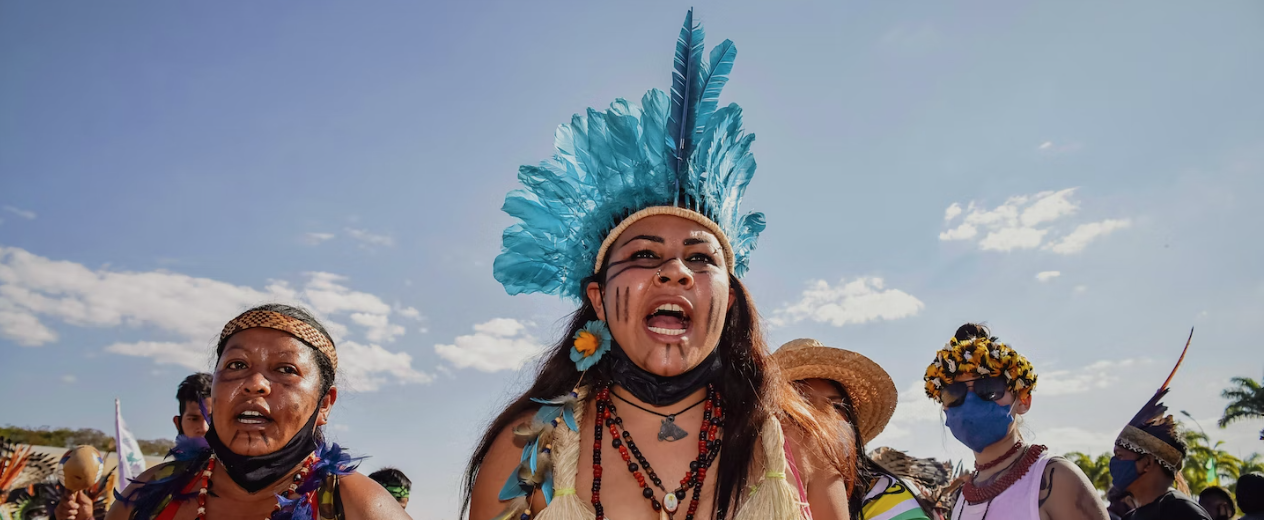
Indigenous people in Brazil have been kept out of the parliament and political representation for a long time. Wapachina is the first and only Indigenous representative in the congress. Despite her importance and fame among Indigenous people, her voice is often muffled in the anti-Indigenous agendas. However, Indigenous groups are gaining international recognition because of their advocacy with the help of Wapachina. In April 2022 Indigenous groups protested in Brasilia, in on eof the largest Indigenous protest ever. This came as a response to the Marco Temporal which threatens the very livelihood of Indigenous people (Fishman, 2021). It is unclear whether Marco Temporal got postponed until later in the year because of the protests or because of other legal issues within the congress, however, Indigenous groups were able to get attention from everywhere in the world.
Indigenous groups with collaboration with NGOs have condemned Bolsonaro’s actions against the Amazon rainforest, claiming it is crimes against humanity and genocice (Weisbrod Surma, 2021), because of the fatal effects mercury has had on Indigenous people of the area. They are additionally looking into criminilizing his crimes against the rainforest because of the losses he has caused to “the lungs of the Earth”. In a desperate letter, Human Rights watch addresses FUNAI, asking to revoke their anti-Indigenous resolutions (concerning the definition of Indigenous): “Resolution n° 4/2021 contradicts the agency’s own preceding understanding on membership in an Indigenous community and violates international law. By establishing that recognition of an individual by an ethnic group should be consistent with “a definition based on technical/scientific criteria,” as well as other criteria, the resolution violates Indigenous peoples’ right to autonomously determine their membership. The language also suggests that there is something “scientifically” measurable or distinct about Indigenous peoples, a degrading notion reminiscent of colonial theories on racial inferiority” (Human Rights Watch, 2021). Despite their attempts to improve their situation internally, Indigenous people of Brazil have been fighting without much left to go.
A world without Bolsonaro: the continuation of Bolsonarism
Even though Bolsonaro was in term for mere 4 years, his populist strategies gained him extensive popularity, even among those underprivileged and poorer people. Bolsonarism is a new term referring to an ideology related to Bolsonaro’s mixture of capitalism and militarization into his politics. Because of the fragility of the Brazilian population and the serious social divide among people, this ideology has been widespread. Many Brazilians report their approval for a military rule, and evidence can be drawn how previously infamous Lula only won by a small margin. Because of this ongoing ideology, even if Bolsonaro is gone, it will be difficult for the people to let go of such ideologies. Especially with the massive investments he gave private investors and miners during his presidency, whom all support him fervently.
The implications of his political actions against Indigenous people, like single handedly appointing an amateur to run FUNAI, persecuting of Indigenous leaders and direct attacks on Indigenous territories are all examples of Bolsonaro’s authoritarian political approach. His actions, thus, do not pose serious human right violations against Indigenous people, but also against the foundational, young democracy of Brazil. His exclusive, openly racialized policies, speeches, and exploitation of the Amazon rainforest are forms of his populism, which gained him approval and power in the congress and among the people. The implications of Bolsonarism will be felt in the years to come in Brazil.
Works Cited
Fishman, Andrew. “Brazil’s Indigenous Groups Mount Unprecedented Protest against Destruction of the Amazon.” The Intercept, The Intercept, 28 Aug. 2021,
https://theintercept.com/2021/08/28/brazil-amazon-indigenous-protest/.
France 24. “Brazil’s Bolsonaro Warns Virus Vaccine Can Turn People into ‘Crocodiles’.” France
24, 18 Dec. 2020,
https://www.france24.com/en/live-news/20201218-brazil-s-bolsonaro-warns-virus-vaccin e-can-turn-people-into-crocodiles.
Human Rights Watch. “Brazil: Indigenous Rights under Serious Threat.” 9 Aug. 2022, https://www.hrw.org/news/2022/08/09/brazil-indigenous-rights-under-serious-threat.
Kimbrough, Liz. “2020 Fires Endangering Uncontacted Amazon Indigenous Groups.” Mongabay Environmental News, 13 Nov. 2020, https://news.mongabay.com/2020/10/2020-fires-endangering-uncontacted-amazon-indige nous-groups/
Menezes, Roberto Goulart, and Ricardo Barbosa. “Environmental Governance under Bolsonaro: Dismantling Institutions, Curtailing Participation, Delegitimising Opposition.” Environmental Governance under Bolsonaro: Dismantling Institutions, Curtailing Participation, Delegitimising Opposition, vol. 15, no. 2, 2021, pp. 229–247.,
Pellegrini, Diana de, et al. “O Brasil Respeita o Direito Dos Povos Indígenas à Educação Superior? Demanda, Oferta E ENSAIOS Alternativos Em São Gabriel Da Cachoeira/AM.” Educação & Realidade, vol. 46, no. 4, 2021, https://doi.org/10.1590/2175-6236118188.
Prange, Astrid. “Has Jair Bolsonaro Backed Brazil’s Indigenous People?” DW, 1 Oct. 2022, https://www.dw.com/en/fact-check-has-president-jair-bolsonaro-really-backed-brazils-indi genous-people/a-63015556
Somma, Marina. “What Are the Resources of the Amazon Rainforest?” Sciencing, 2 Mar. 2019, https://sciencing.com/resources-amazon-rainforest-7214334.html.
Webb, Hannah, and Raquel Nunes Palmeira. “Bolsonaro: Trump of the Tropics” Socialist Lawyer, no. 80, 2018, https://doi.org/10.13169/socialistlawyer.80.0018.
Weisbrod Surma, Katelyn. “Are Bolsonaro’s Attacks on the Amazon and Indigenous Tribes International Crimes? A Third Court Plea Says They Are.” Inside Climate News, 11 Aug. 2021, https://insideclimatenews.org/news/11082021/amazon-indigenous-tribes-jair-bolsonaro-i nternational-criminal-court/.
World Bank. “Brazil – Employment in Agriculture (% of Total Employment) 2022 Data 2023 Forecast 1981-2020 Historical.” Brazil – Employment In Agriculture (% Of Total Employment) – 2022 Data 2023 Forecast 1981-2020 Historical https://tradingeconomics.com/brazil/employment-in-agriculture-percent-of-total-employ ment-wb-data.html
